
Newburgh Directory Holdings
Newburgh directories survive in several local and state collections, but they do not form one uninterrupted online run. The Newburgh Free Library describes its holdings as reaching back to the 1860s. The Historical Society of Newburgh reports directories from the early nineteenth century and says it holds copies of most volumes. The New York State Library supplies another route through listed fiche and film. Together, those shelves make a city directory useful for a dated name or address search, even when a particular year is absent at one repository.
| Collection | Years or material | Where held | Access route |
|---|---|---|---|
| Newburgh directories | Early nineteenth century at the Society; library holdings back to the 1860s | Newburgh Free Library and Historical Society | Reference and archive research |
| New York State Library directory reels | Fiche: 1856/57, 1858-59, 1860/61; film: 1864/65, 1872/73, 1874/75, 1879-84, 1887, 1889, 1898-99, 1901-31, 1937-42/43, 1946-48 | New York State Library | Fiche and film catalog route |
| Telephone directories | Library: 1930s through early 2000s; state film: 1940/41 and 1950/51 | Library and State Library | Reference or film access |
| Street-address searching | Available from 1918 in later city-directory volumes | Library and Historical Society | Find the street section, then compare the name section |
The official catalog material identifies repositories and runs, not a verified publisher for every edition. Check the volume's title page before recording a publisher. Use the Newburgh Free Library Local History Collection, the Historical Society research guide, and the New York State Library directory catalog as complementary access channels.
Note: A missing volume can be a collection gap, not proof that a household was absent.
Digitized Newburgh Before 1920
The City of Newburgh Digital Collection provides an online archive for Parish, Village, City, and Town Newburgh material from 1791 into the early twentieth century. It is a strong companion to a printed directory volume, especially when an entry needs local context from a map, photograph, manuscript, or municipal item. It is not a substitute for a complete digitized directory run, because the research did not locate a standalone page-level directory series there.
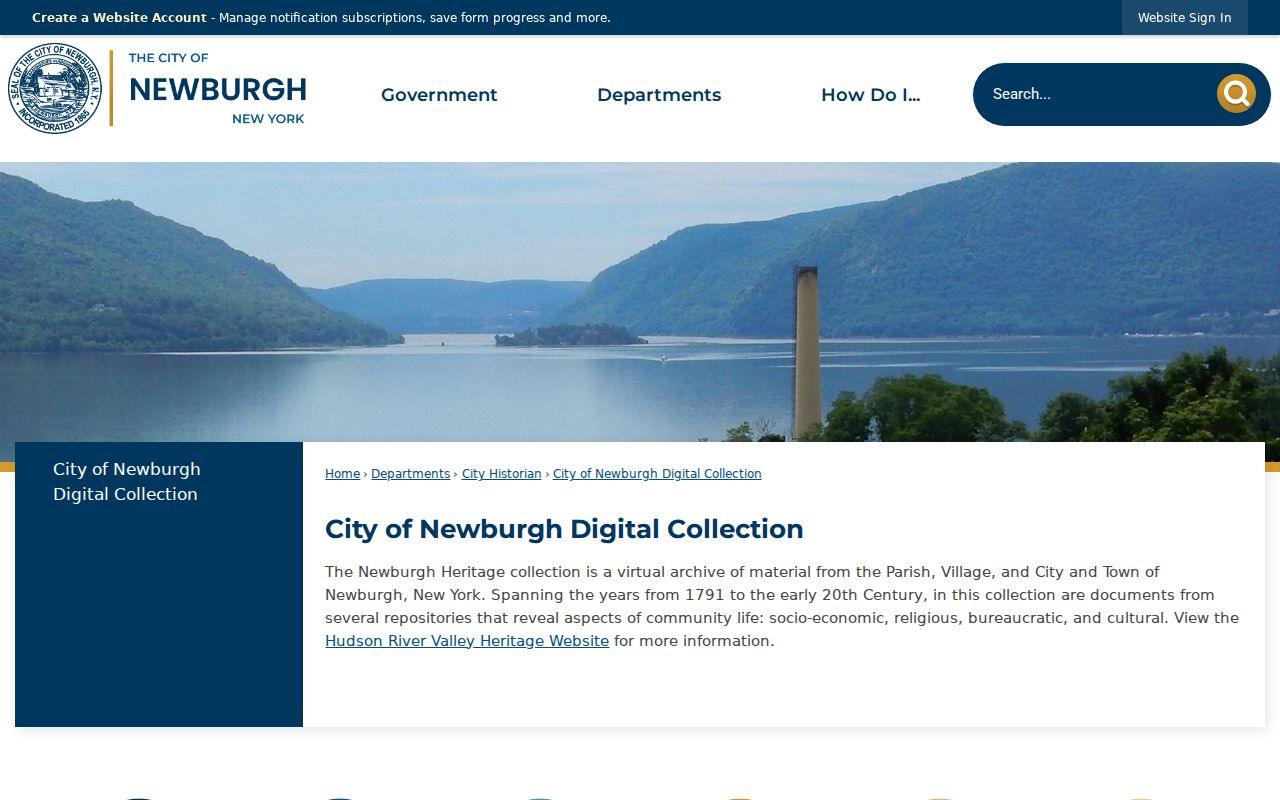
Repository metadata matters. A digitized item may refer to the City, Town, Village, or Parish of Newburgh, so keep the creator, date, and jurisdiction with every city-directory note. That distinction protects a family-history search from merging records that share the Newburgh name but came from different custodians.
Newburgh Directory Research Desks
For material that is not online, the Newburgh Free Library at 124 Grand Street is the practical first stop. Its Local History Resource Center brings together directories, newspapers, maps, photographs, postcards, yearbooks, selected cemetery material, and family and church histories. Reference staff can help identify a directory year or a related source, while licensed database access may be available through the library. The library lists a reference number of 845-563-3617 for research help.
The Helen Gearn Memorial Library of the Historical Society of Newburgh, at 189 Montgomery Street, holds books, documents, photos, maps, and ephemera focused on local people, businesses, and architecture. Archive use requires an appointment and a written research question; listed research hours are Tuesday through Thursday, 2:00 to 6:00. Its catalog can point to holdings, but many photos, documents, and ephemera are not scanned.
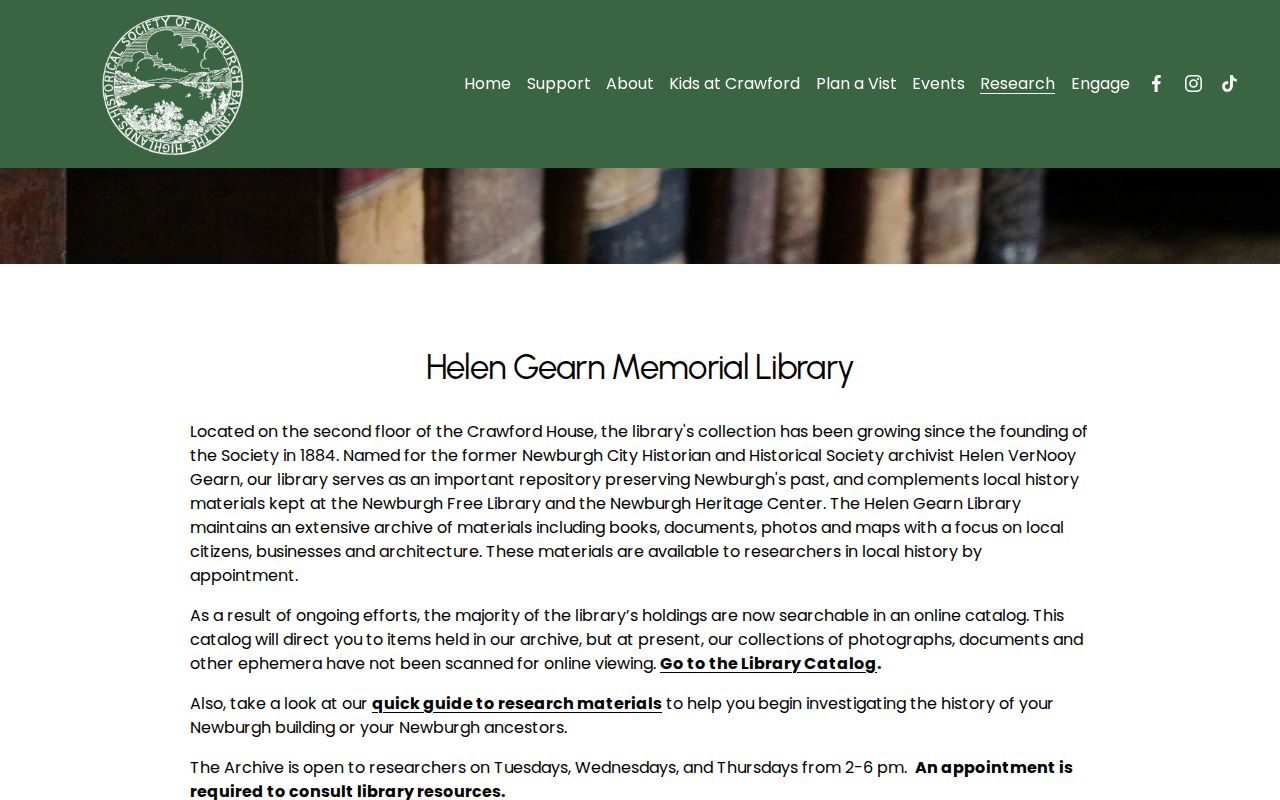
The archive route is especially useful when a Newburgh directory leaves an unexplained gap. An entry, clipping, map, or photograph can supply different evidence, so keep the repository and page or item reference rather than combining them into one unsupported conclusion.
Reading a Newburgh Directory Entry
A Newburgh city directory entry is a printed, dated observation. It can place a name at an address or within a household context, but it does not independently prove ownership, a full household, or a later move. The Historical Society reports that later entries may include an address, occupation, marital-status information, and legal-age household residents. Copy what the volume actually prints, including initials and punctuation. The exact abbreviation key and a page-level sample from a Newburgh volume were not captured in the research, so do not guess at a mark's meaning.
| Edition and page | The year and repository page reference that fix the entry in time. |
|---|---|
| Name as printed | Use the spelling, initials, and surname cross-reference from the volume. |
| Street address | Later Newburgh directory volumes support street-address searching from 1918. |
| Household detail | Legal-age household residents or marital-status information may appear, depending on the edition. |
| Occupation | A printed field that can separate similarly named people when paired with address and date. |
- Criss-cross directory
- A directory section arranged by street and address instead of surname, used in Newburgh from the 1918 street-address era.
- Householder index
- A name-based arrangement that helps return from an address lead to a printed household entry.
- Abbreviation key
- The volume's own explanation of shortened terms; preserve it with the citation rather than assuming a meaning from another edition.
Newburgh Directories Shift After 1918
Newburgh's directory method changes with the date. Before 1918, the Historical Society describes the books as surname-alphabetical without an address cross-index. Begin with a family name for that period, then use deeds, census schedules, maps, or newspapers to test an address. From 1918 onward, the street-address section and surname searching make an address-first household trail possible. This change is valuable for people tracing past residents of a particular Newburgh property, but each printed name still needs a role and date.
The same date awareness applies to census research. New York state census records are described for 1825-1875, then 1892, 1905, 1915, and 1925. The Historical Society reports that a 1911 fire destroyed many state-census records. An absent record in that gap is not evidence that a family was not in Newburgh. Check county copies where available, a directory edition on either side, and the federal schedule subject to its public-release rule.
- 1836: Newburgh Library Association formed.
- 1838: Mechanics Library Association formed.
- 1865: Newburgh Free Library was reconstituted.
Trace Newburgh Households Through Directories
Family-history work with a Newburgh directory volume becomes stronger when one entry leads to the next source rather than standing alone. Start with a known surname, address, or year. Record the exact form of the name, then compare nearby editions for an address change, an added household name, or a disappearance. A telephone directory can extend the address trail later than some city-directory volumes, although it identifies a subscriber rather than every person at that address. The collections themselves remain the best place to inspect the page.
- Locate the first confirmed name or address in a dated Newburgh city directory and note the edition and page.
- For a post-1918 address, read the street section and record every printed name and role before moving to the alphabetical entry.
- Compare the preceding and following available editions, preserving vacant, omitted, or changed address text rather than filling a gap by assumption.
- Pair the directory year with the closest available state or federal census, while marking the 1911 state-census loss as an availability issue.
- Use a deed, assessment roll, obituary, or probate file only for the question that source can answer, such as recorded title or an estate endpoint.
For a modern parcel or current address trail, use the Newburgh street directory rather than treating a historical directory as a current record.
Note: A disappearance may reflect a move, death, omission, or changed indexing practice, so the next dated source is needed before drawing a conclusion.
Newburgh Directory Map Context
A city-directory address can also be placed against the 1913 Newburgh Sanborn map set, which has 69 public-domain sheets at the Library of Congress. A sheet can show a building footprint, material, floor count, use, street, and fire-risk notation. It cannot identify the person who occupied a building. Pair a map observation with a dated directory entry or deed and keep the two claims separate.
Newburgh geography needs the same care. East End, Hillside, waterfront, Heights, Downing Park, and Broadway are historic, planning, landmark, or descriptive layers with different meanings. They can help orient an address search, but none should be substituted for a legal boundary or a household record.
Newburgh Directory Follow-Up
When a directory lead needs confirmation, choose the custodian by record type. The City Clerk maintains city archives and local vital-record routing, while the Orange County Clerk holds deeds, mortgages, maps, and older county books. The library and Historical Society preserve the historical shelf. Keep City of Newburgh, Town of Newburgh, and Orange County in the research note, since the postal place name alone cannot identify the right office. A precise request names the municipality, street address, date range, and record type.
For a City of Newburgh property file that is not published online, the documented fallback is a targeted request through the city FOIL route. Building and code files can document permits, inspections, violations, fires, and renovations, but not a complete household history or building plans. For county deeds, a book/page lead from a directory-era property search belongs with the Orange County Clerk. For statewide holdings, the State Library's film and fiche route remains useful. Ask each custodian for the access method, any redactions, and the correct record identifier before assuming a file is unavailable.
Note: Preserve the request date, access response, source reference, and stated reason whenever a Newburgh record cannot be supplied.